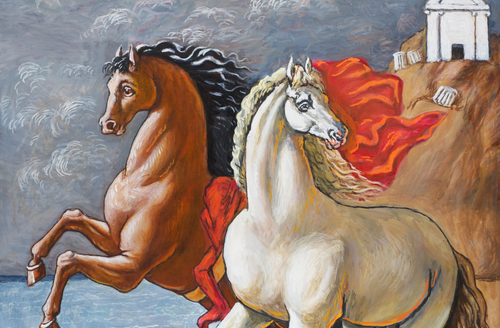
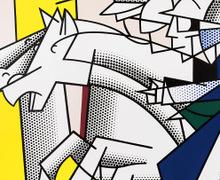
Think of it as an artistic stampede.
"Soft Reins: From Degas to Fordjour," an exhibition that looks at equestrian imagery and inspiration in art, is on view through March 22 at Acquavella Galleriesin the Royal Poinciana Plaza.
Curated by artist Tomokazu Matsuyama, the exhibition features art by Fernando Botero, Will Cotton, Edgar Degas, Raoul Dufy, Derek Fordjour and Lucian Freud.Also included are works by Roy Lichtenstein, Sarah Miska, Pablo Picasso, Robert Longo, Tom Otterness, Susan Rothenberg and Matsuyama.
"The origin of Soft Reins grew out of thinking about how deeply equestrian imagery has shaped visual culture across different histories, yet how narrowly it is often understood today," Matsuyama said.
While horses have long been associated with power and action, their presence in artis more layered and emotionally complex when examined across cultures and eras, he said.
The show's title, "Soft Reins," draws on the relationship between horse and rider, he said: When reins are held gently, a horse will respond to its rider more throughintuition than physical force.
"This idea became a guiding metaphor for the exhibition," Matsuyama said. "Rather than centering on dominance or control, the show reflects on balance, sensitivity, restraint and mutual awareness — qualities that feel increasingly relevant in thepresent moment."
Matsuyama said he is particularly interested by how the horse functions as anartistic muse in a way that shifts while still remaining "deeply resonant across time and geography."
An exhibition of equestrian-inspired art is particularly relevant in Palm Beach County, home to a large equestrian community that includes Wellington, known asthe winter equestrian capital of the world.
Matsuyama spoke via email with the Daily News about "Soft Reins."
When and why did you first begin using the horse as a symbol in yourown work?
Equestrian imagery first entered my work through my broader interest in how historical symbols move across cultures and accumulate layered meanings overtime. The horse, in particular, appears repeatedly at moments of transition throughout history, especially in relation to nations, belief systems, and artistic traditions.
In my work, I want to shift the focus away from the rider as this heroic figure and toward the horse itself, understood as a carrier of movement and memory. The horse not only functions as a living being but also as a vessel, transporting ideas, identities, and visual languages across time and geography. Because of the rich history of horses in visual art, when depicting the creature, multiple of these histories can coexist within a single, layered composition.
Working with the horse makes it possible to engage a familiar historical motif while loosening it from any single lineage. Rather than being shaped by authority orconquest, the image emerges through accumulation and continual reinterpretation.
Why was it important to include such a wide range of forms, including playful and abstract approaches?
The breadth of approaches in the exhibition was very intentional. Equestrianimagery is often encountered through a limited set of conventions — realism, sport,hunting or traditional portraiture — but those frameworks only partially reflect howartists have engaged with the horse over time.
In "Soft Reins," the horse appears in many forms: as myth, abstraction, formal device, psychological presence and even fantasy. Some artists use the horse to explore gesture and composition, allowing it to move fluidly between abstractionand representation, while others introduce elements of playfulness or surrealism drawn from broader visual cultures. Elsewhere, the horse reemerges as a mythic or classical figure, carrying echoes of earlier artistic languages.
Bringing these varied approaches together allows the exhibition to remain open anddynamic. Rather than proposing a single definition of equestrian imagery, Soft Reins highlights its flexibility and expressive range. That diversity reflects the largerpremise of the exhibition — that meaning arises not through fixed hierarchies orrigidity, but through responsiveness, variation and exchange.
Are there one or two pairs or groupings of works in the exhibition that feel in conversation with each other that visitors should pay special attention to?
One particularly resonant dialogue in the exhibition emerges between historicalworks such as Giorgio de Chirico’s "Due cavalli in Riva al Mare" and morecontemporary approaches to equestrian imagery. De Chirico’s horses seemsuspended between myth and modernity — anchored in classical reference yetcharged with psychological tension. Seen in proximity to contemporary works, thissense of timelessness becomes more pronounced, allowing the motif to unfoldacross different visual languages.
Another meaningful contrast appears between artists who approach the horse as asymbolic or mythic presence and those who engage it as a formal or conceptualstructure. In Susan Rothenberg’s work, for example, the horse functions as aframework for exploring movement, memory and painterly language, while otherworks place greater emphasis on narrative, storytelling and cultural reference.
Rather than pairing works to imply direct influence, the exhibition encouragesviewers to observe how artists across generations return to the same motif fordistinct and personal reasons. These quiet, unfolding conversations across timeform an essential part of the experience of "Soft Reins."