Henri Matisse (b. 1869; d. 1954) was the star of the Museum of Modern Art’s first solo show in 1931. The exhibition comprised more than 130 works and was visited by thousands. Close to a century later, Acquavella’s current Matisse exhibition includes only fifty works—paintings, sculpture, and works on paper—but the lines outside the gallery prove that Matisse’s popularity has not waned.
But the Matisse of 1931 is not the Matisse of 2026. What did American viewers in the time of Grant Wood (b. 1891; d. 1942) and Thomas Hart Benton (b. 1889; d. 1975) think if they were seeing Matisse for the first time? Did he represent the cutting edge of modernity or was he already a painter from the past, a nineteenth-century artist still working in the twentieth? For us, Matisse is history, part of a coherent narrative that runs from Impressionism to Vincent van Gogh, to Paul Cezanne, to the Fauves. His work is a mainstay in prominent museums and art history classes alike, so he has acquired the status of a classic.
Like us, Matisse also went to exhibitions. We don’t have to stretch too far to imagine how he might have reacted to the van Gogh retrospective, made up of seventy-one paintings, that was mounted in Paris in 1901: Matisse already owned drawings by van Gogh and had imitated him in portraiture and still life. A similar dynamic recurs in Matisse’s fascination with Cezanne, whose work he also owned. Matisse did not suffer from any kind of “anxiety of influence.” He took the work of his forbearers as models to assimilate and develop without hesitation. Perhaps Matisse’s status is best defined by the fact that in 1930, Albert Barnes took the then-unusual step of commissioning him to paint a mural (The Dance [1932–33]) for his museum: a living artist creating an instant museum piece.
Navigating the two-floor show at Acquavella requires some dexterity. The best approach is to begin in the ground floor north gallery, where the earliest pieces are displayed. Next, go up to the second floor, sticking to the north side. Here are myriad sculptures accompanied by early works. Then, remaining on the second floor, walk south to see later pieces. Only then return to the ground floor south gallery, which contains more later work and the four bronze castings of Matisse’s sublime “Back” series. This rare opportunity to see them all together makes for an extraordinary conclusion to the exhibition.
On the first floor, the painting Male Model (ca. 1900) and the bronze accompanying it, The Serf (1900–04), create an ideal point of entry both for this exhibition and for Matisse’s career. The painting is a reinvention of a classic academic genre: a life class exercise depicting a naked male model. For Matisse, this represents the opportunity for a virtuoso performance. The background colors locate the figure in an abstracted space only possible in art. The figure, clearly showing the affinities between the Fauves and the Expressionists, is roughly drawn, the body composed of geometric shapes in different shades. He stands on a table or box, a potbellied stove to his left in a corner to create perspective and depth. The academic exercise explodes before our very eyes. This is confirmed by the accompanying statue: the model, no longer in profile, faces the viewer, devoid of arms. The surface is rough, looking back to van Gogh’s brushwork and forward to Willem de Kooning’s clamdiggers.
On the second floor, the portrait Mademoiselle Yvonne Landsberg (1914) is another masterful act of reimagination: here Matisse utterly transforms portraiture. Ms. Landsberg, demurely posed with her hands crossed over her lap, is either standing or perched precariously on a tall chair. Her face is reduced to a few lines, and all around her swirl whirling lines of force, as if she emanated some strange electricity. As he did with Male Model, Matisse takes a cliché and turns it into something new and wonderful.
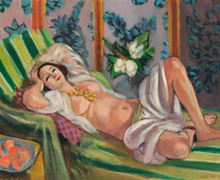
The same impulse to remake established forms prevails in Matisse’s manipulation of still life and the motif of the odalisque, or concubine. The Géranium (1910) is only about 18 by 22 inches, but its small size belies its significance. In this work Matisse flattens the perspective so that the plant rests on the merest suggestion of a table. What comes to the fore is color: pale purple to the left, dark to the right, with the geranium’s green leaves dominating our view. Another potentially trite image reinvigorated by Matisse’s formal gamesmanship. Jean-Auguste-Dominique Ingres may well have set the standard for depiction of the figure of the odalisque with his Grande Odalisque of 1814, but Matisse’s Odalisque with Magnolias (1923) simultaneously liberates the image from Ingres’s high seriousness and the Orientalist fantasies of the nineteenth century. The image is a riot of color where erotic sensuality is subordinated to composition, the juxtaposition of shapes.
It is in his bronzes that Matisse most dramatically shows his abilities as a genuinely original innovator, not just a reinventor of traditional compositions. The five “Jeannette” bronzes created between 1910 and 1913, small in scale—the largest is just 24 by 10 by 11 inches—demonstrate Matisse’s evolving freedom from tradition more directly than what we find in his paintings. Jeannette I (1910) is quite representational in a conventional sense, but by the time we get to Jeannette V (1913), the subject’s face has been thoroughly abstracted, transformed into a chunky mask. The “Backs” series shows us this trajectory as well. In these four iconic and increasingly abstracted relief sculptures Matisse challenges Michelangelo’s Young Slave, reconfiguring the idea of the figure embedded in the medium—marble for Michelangelo, bronze for Matisse.
The Acquavella Matisse show is a rare opportunity to catch up on a master. Best absorbed chronologically, the exhibit is a historical tour de force.